Expression of Interest · Knowledge Management & Website Development Services · 5 September 2026
A marine ministry the world looks to, starting with its front door.
Tu'anga o te Pae Moana manages 1.8 million square kilometres of ocean on behalf of about 15,000 people spread across 15 islands. Its knowledge, its data and its services deserve a digital home that matches that responsibility. This is our proposal for how to build it, and for how to make it the best of its kind among small ocean states.
Government of the Cook Islands · Tutakimoa, Rarotonga EOI contact: Lisa Williams
Prepared by
Sunrise Labs
Research & development lab · Mauke, Pa Enua Lead: Ian Tairea
EOI timeline
Released 31 Aug · Closes 18 Sep 2026, 4pm
This page accompanies the Ministry's completed EOI form and carries our full response, including indicative scope and investment
01
Executive summary
The EOI asks for two things: a practical knowledge management strategy, and a modern, accessible public website. We propose to treat them as one system, and to aim higher than "a new website".
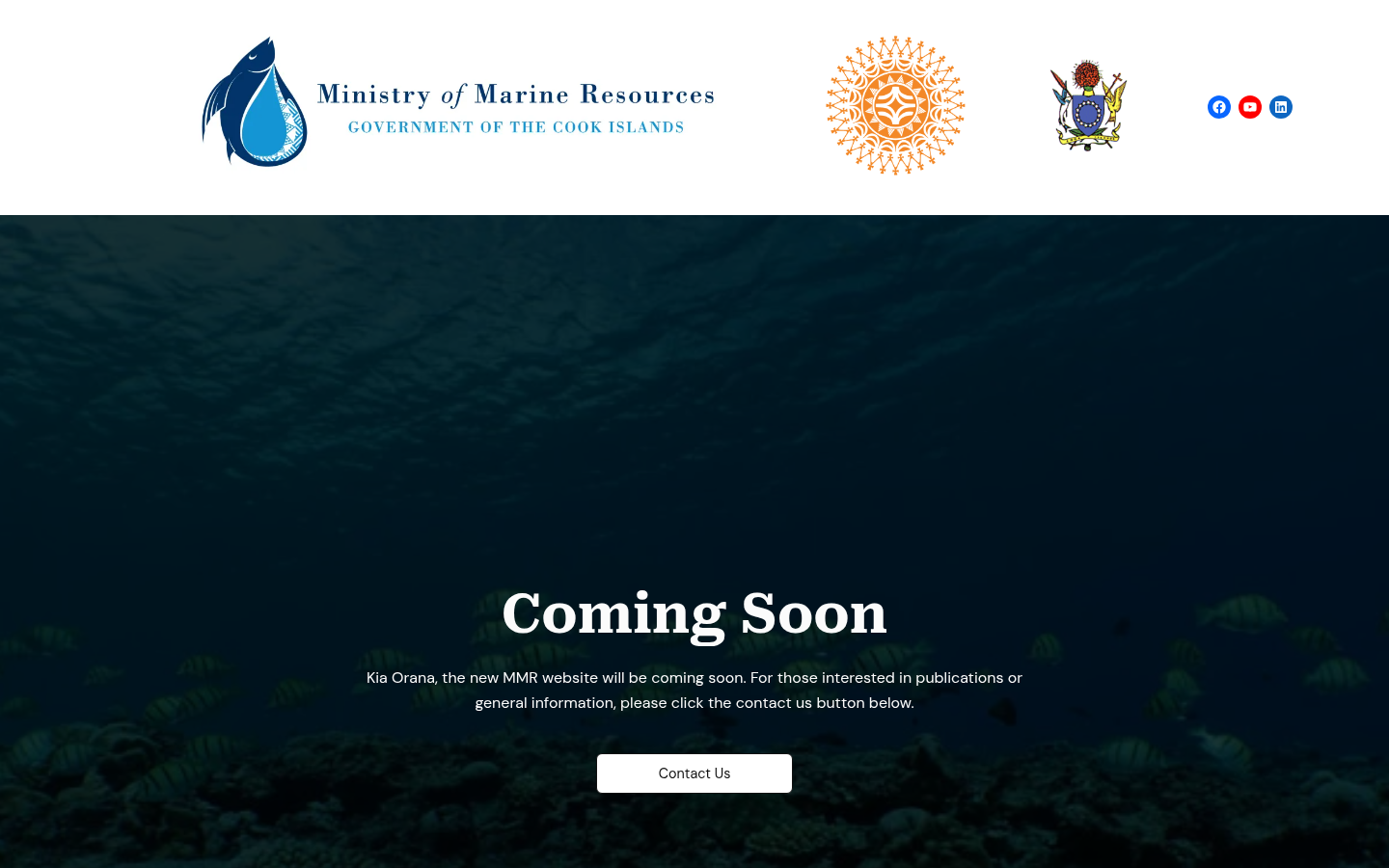
Where things stand. mmr.gov.ck has shown a "Coming Soon" page since late 2024. The site it replaced was organised around the Ministry's five divisions rather than around what people need, its news stopped for five years, and its document library held nine files. Meanwhile the Ministry itself runs some of the most sophisticated work in Cook Islands government: a quota management system, a 24-hour Oceans Monitoring Centre, water-quality monitoring since 2004, a ra'ui survey programme, a pearl research station in Manihiki and a food safety laboratory. Almost none of it is visible online.
What we propose. A knowledge management strategy that makes the Ministry's knowledge findable inside and outside the building, and a public website built as ten flagship features on top of it: an intent-based front door, a searchable knowledge hub, an offline-capable fishing rules and ra'ui guide, live lagoon and ocean health data, an ocean transparency portal, online licensing and services, a signals and alerts network, a Pa Enua layer built for low bandwidth and two languages, learning pathways, and an internal insight dashboard.
Why it can be world-leading. No comparable agency we reviewed combines transparency, community management, bilingual delivery and outer-island inclusion in one place. New Zealand has the best fishing-rules app. Australia has the best licensing portal. Norway publishes the most open data. Global Fishing Watch shows what public vessel tracking looks like. The Cook Islands is small enough, and its Ministry capable enough, to do all four at once. That would be a first.
How we would deliver. Discovery and the KM strategy first (October to November 2026), then three build phases through August 2027, each shipping working features. Everything is open-source, owned by the Ministry, exportable, and hosted where the Ministry chooses. Pricing is modular: pick the phases and features that fit the budget.
10
flagship features, each priced and phased independently
2
languages: Cook Islands Māori and English, throughout
15
islands served, including offline and SMS fallbacks for Pa Enua
100%
Ministry-owned: open-source stack, no lock-in, full data export
02
What the EOI asks for, and where we answer it
Every line of the call for expressions of interest, mapped to this response.
EOI requirement
Our response
Where
Co-design, development and implementation of a knowledge management strategy
A five-step KM programme: knowledge audit, taxonomy and governance, capture workflows, tooling, and staff enablement. Delivered as a strategy document plus a working knowledge hub, not a report that sits on a shelf.
Ten flagship features on a bilingual, WCAG 2.2 AA, mobile-first platform. Built intent-first around what fishers, operators, farmers, students and partners actually need.
Experts in knowledge management, web development and digital content systems
Sunrise Labs is an R&D lab, not a web agency. We build knowledge systems and public digital infrastructure in the Cook Islands and are based in the Pa Enua ourselves.
Experience with public-sector or non-profit websites
Recent work includes a full flagship-feature specification and proposal for the Ministry of Agriculture, community digital infrastructure for Mauke, and platforms for Cook Islands education and civil-society organisations.
Support digital inclusion for Pa Enua (outer islands)
A dedicated Pa Enua layer: offline-capable pages, low-bandwidth mode, SMS broadcast, island pages co-owned with island fisheries officers, and printable one-pagers for notice boards.
Align with the Cook Islands National Digital Strategy 2024–2030
Mapped to the strategy's Government and People pillars: digital public services, inclusion, digital-identity readiness and Pa Enua connectivity. Each feature notes its alignment.
We reviewed the live site and 278 archived captures of mmr.gov.ck going back to 2001. The findings below are observations, not criticism: they define the starting line.
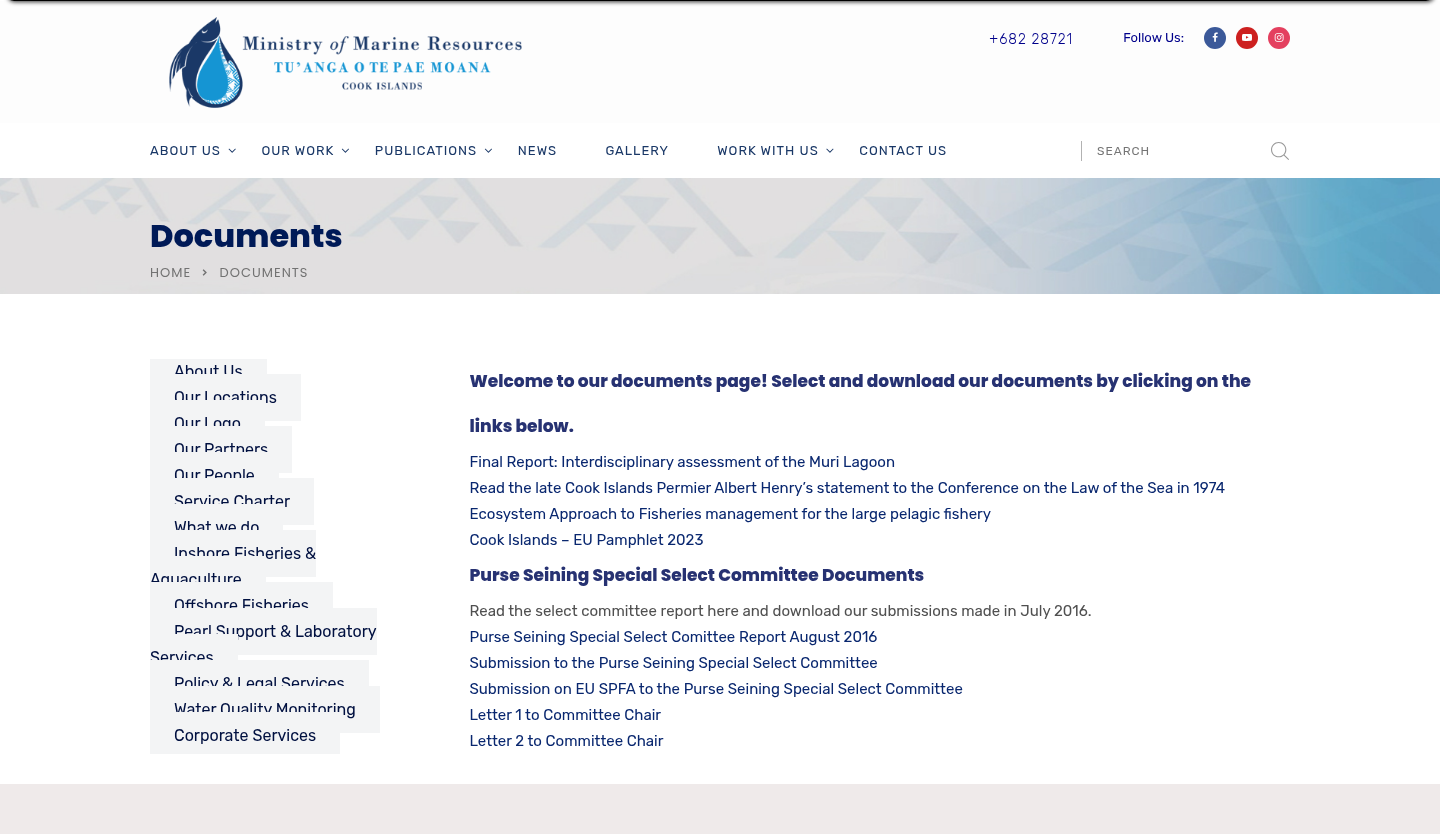
mmr.gov.ck, September 2026Coming Soon since late 2024Archived Documents page, March 20249 documents · broken sidebar
What we found
●
No public website for almost two years
The holding page has been live since late 2024. Every enquiry it would have answered now goes to the phone line or the front desk at Tutakimoa.
The previous site's main menu was the Ministry's five divisions. A fisher in Mangaia wanting to know the rules had to guess which division owned them.
Navigation: About · Our Work (5 divisions) · Publications · News · Gallery · Work With Us
●
Knowledge was thin and hard to find
The document library listed nine files. Legislation was a flat list of PDFs. The archived annual offshore fisheries reports run from 2014 to 2016. There was no search that worked across content.
Three posts in December 2023 sat above three from 2018. Some story URLs still carried the theme's demo slugs, so a story about a marine organism lived at an address about "managing finances".
/2018/11/28/mistakes-of-managing-finances/ → "'By-the-wind sailor' no threat"
●
Template debris was publicly indexed
Search engines had indexed leftover theme demo pages: case studies, a shopping cart and checkout, Spanish-language shop pages, events and a fictional staff list. This erodes trust and dilutes search results for real content.
WordPress with a page-builder plugin, a slider plugin and a theme framework. Fine for a brochure, but slow on island connections and costly to keep secure and updated.
Reconstructed from the archived site and public sources. The services exist and are substantial. The gap is that they are not online.
Offshore licensing & quota
Longline and purse seine licences; Quota Management System for albacore and bigeye since 2017; TACC 9,698 t albacore, 2,500 t bigeye.
Not online
Oceans Monitoring Centre
Vessel monitoring, observers, port sampling, catch reporting and compliance for all licensed vessels in the EEZ and on the high seas.
Not online
Inshore fisheries & FADs
Subsistence and commercial inshore management, the national FAD programme, officers on eight Pa Enua islands, Araura Marine Research Centre in Aitutaki.
Description only
Ra'ui monitoring
Surveys of traditional marine protected areas since the Koutu Nui revived ra'ui in 1998; recognised indicator of reef and lagoon health.
Description only
Water quality monitoring
Stream, lagoon and groundwater sampling since 2004 with the National Environment Service, Infrastructure Cook Islands and Te Marae Ora; audited by NIWA.
Data not published
Pearl support & laboratory
Pearl biology station in Manihiki, Tongareva Marine Resources Centre in Penrhyn, marine and food safety laboratory services for stakeholders.
Not online
Conservation
1.2 million km² shark sanctuary since 2012, whale sanctuary, National Plan of Action for sharks, bonefish and pasua by-laws.
Description only
Policy, legal & international
Marine Resources Act 2005 and regulations, WCPFC and FFA obligations, MSC-certified albacore longline fishery, treaty and access arrangements.
PDF list only
04
What world-leading looks like
We looked at the marine and fisheries agencies people point to as the best. Each does one thing exceptionally well. None does all of them.
Agency
What they do best
What we take from it
Fisheries New Zealand
The NZ Fishing Rules app: region-by-region bag limits and sizes, species identification by photo, local closure notices, biotoxin alerts, works offline. It is the principal channel for rules.
An offline-first rules and ra'ui guide, per island, with species ID and closure status.
AFMA (Australia)
The GoFish business portal for licences and permits; an interactive map of all Commonwealth fisheries; Catchwatch catch-data reports; a dedicated illegal-fishing hotline.
Online licensing and quota with status tracking; a public fisheries map; a clear reporting channel.
NOAA Fisheries (USA)
A species directory with regional filtering; "story maps" for major initiatives; permits, funding and data in one Resources hub.
A species and habitat directory that doubles as school material; storytelling for Marae Moana.
Fiskeridirektoratet (Norway)
A 24/7 Fisheries Monitoring Centre; open statistics for fisheries and aquaculture; real-time closures; a catch-documentation programme.
Publish the Oceans Monitoring Centre's outputs as open, delayed, aggregated data.
Global Fishing Watch
Free public tracking of 100,000+ vessels; a Vessel Viewer with identity and history; an open API. Governments partner to publish their VMS data.
Electronic reporting mandated through licence conditions (May 2026); e-PSM port inspections; e-CDS catch documentation under development; regional MCS dashboard.
Build the website to sit on top of these systems, so regional data flows into public pages without re-keying.
The gap no one has filled
Big agencies are transparent or community-based or bilingual or built for remote users. They are rarely all four, because at their scale it is hard. The Cook Islands has 1.8 million km² of ocean, one Ministry, 15 islands and two languages. That is exactly the scale at which all four can be done at once, and done well.
A Ministry that publishes its ocean data, its lagoon health, its rules in both languages and its services online, and does it in a way an aunty in Pukapuka can use on a phone, would be a reference point for every small island state on earth.
Transparent like Norway and Global Fishing Watch
Practical like New Zealand's rules app and Australia's portal
Community-rooted through ra'ui, island councils and Koutu Nui
Bilingual and inclusive for every island, on any connection
Aligned with FFA, WCPFC, SPC and the National Digital Strategy
05
Design principles
Six commitments that shape every feature. Each one also maps to a pillar of the National Digital Strategy 2024–2030.
Intent first, not org chart first
The site asks what you are trying to do, not which division you need. Divisions still exist, one click deeper. Government pillar
Two languages, everywhere
Cook Islands Māori and English side by side on every page, with dialect notes where island usage differs. Not a translated afterthought. People pillar
Built for the slowest connection
A performance budget for 3G-class satellite links. Pages under 300 KB, offline caching for rules and guides, SMS as a fallback channel. Infrastructure pillar
Open by default
If the Ministry collects it with public money and publishing it does no harm, it should be published as data, not only as a PDF. Delayed and aggregated where sensitive. Government pillar
Evidence-linked
Every number on the site links to its source document. Every rule links to its regulation. Trust is built on traceability. Regulation pillar
Owned by the Ministry, forever
Open-source software, content in open formats, hosting the Ministry controls, full export at any time. No vendor holds the keys. Government pillar
06
Ten flagship features
Each is a self-contained module with its own price and phase. Features marked Foundation form the recommended core. The rest lift the Ministry from "has a website" to "leads the field".
01Phase 1
Single Front Door
Ask what people are trying to do, then take them there in one click.
The homepage opens with plain-language choices, not a menu of divisions: I want to fish · I operate a licensed vessel · I farm pearls or grow aquaculture · I need a document or a law · I want to report something · I'm learning about our ocean. Each choice routes to the right feature with the island already selected where it matters.
Persistent "Start here" entry in the navigation and a fast search that understands both languages
Island selector remembered across the site, so Aitutaki bonefish rules show for Aitutaki users
Top tasks surfaced from real usage data, reviewed quarterly
02Phase 1
Knowledge Hub
The public face of the KM strategy: every Act, regulation, plan, report and survey, findable in seconds.
A structured library replacing the nine-file documents page. Every item carries metadata (type, year, island, fishery, species, division, language), a plain-language summary and version history. A search that answers questions across the whole corpus and cites the paragraph it drew from, so a fisher can ask "what is the minimum size for pa'ua in Manihiki" and get the by-law, not a list of PDFs.
Legislation browser with consolidated current versions and superseded history
Reports and scientific surveys with extracted tables, so numbers are data, not scans
Internal, staff-only tier of the same hub for procedures, templates and institutional memory
Question-answering search with citations, running on infrastructure the Ministry controls
03Phase 2
Fishing Rules & Ra'ui Guide
Every rule for every island, in your pocket, working with no signal.
An installable web app (no app-store dependency) that shows the rules that apply where you are standing: size and bag limits, protected species, gear restrictions, seasonal closures, island by-laws and the current status of every ra'ui. Species identification by photo, in both languages, with the Māori names each island uses. Downloads once and works offline for the season.
Ra'ui map with open, closed and partial status maintained with Koutu Nui and island councils
Species cards with legal sizes, a printable ruler and the relevant regulation linked
Local notices and closures pushed to devices when they next connect
Printable island one-pagers generated from the same data for notice boards and schools
04Phase 2
Lagoon & Ocean Health Live
Twenty years of monitoring data, published as living dashboards instead of filed away.
The Ministry has sampled streams, lagoons and groundwater since 2004 and surveyed ra'ui sites for over two decades. This feature publishes that record: a map of monitoring sites with the latest readings, trend charts by site and by parameter, plain-language health ratings, and public health advisories when thresholds are crossed. Every chart links back to the source dataset and method.
Site pages for Muri, Avarua, Aitutaki, Manihiki and other lagoons with nutrient, bacterial and ecological indicators
Ra'ui survey results over time, showing communities the effect of their own management
Open data downloads and a simple API for researchers, schools and partner agencies
Pearl-farm lagoon monitoring for Manihiki and Penrhyn farmers
05Phase 3
Ocean Transparency Portal
Show the world how 1.8 million km² of ocean is managed. Few states can, the Cook Islands could.
A public register of licensed vessels and their licence status; a delayed, aggregated activity map of fishing effort in the EEZ drawn from the Oceans Monitoring Centre or via a Global Fishing Watch partnership; quota allocation and uptake for albacore and bigeye; observer coverage; annual offshore fisheries reports rebuilt as interactive data rather than a PDF. The Ministry decides what is published and at what delay; commercially sensitive detail stays internal.
Vessel register with flag, gear, licence period and MSC status
Effort and catch by fishery and year, with the WCPFC and FFA reporting it feeds
Revenue to the Cook Islands from licences and access, presented honestly and in context
Shark and whale sanctuary boundaries, Marae Moana zones and maritime limits on one map
06Phase 2
Licensing & Services Portal
Apply, pay, track and renew online. For operators in Taipei and farmers in Manihiki alike.
Guided online applications for the Ministry's services: longline and purse seine licences, annual quota purchases, pearl farm and aquaculture permits, aquarium fish and marine product export permits, laboratory test requests, FAD deployment requests and research permits. Applicants see status at every step; officers get a triage queue instead of an inbox. Designed to plug into the national digital identity when it arrives.
Smart forms that only ask what the regulation actually requires, pre-filled on renewal
Document upload, fee calculation and payment reference, with receipts
Internal case view with assignment, notes and turnaround-time reporting against the Service Charter
Built to exchange data with FFA electronic licensing standards and the regional e-PSM system
07Phase 1
Signals & Alerts
Hear from the reef early, and speak to every island instantly when it matters.
Two halves of one nervous system. Signals: anyone can report a fish kill, ciguatera cases, a suspected illegal vessel, crown-of-thorns outbreak, pa'ua deaths, a stranded whale or an unusual organism, with a photo and location, in under a minute. Reports land in a triage view for officers and feed the health dashboards. Alerts: a crisis mode the Ministry can switch on that takes over the homepage with clear guidance during cyclones, tsunami warnings, biotoxin events, oil spills or lagoon closures, and pushes the same message by SMS and social media.
Minimal-fields reporting, no login, works from a phone on the beach
Officer triage with status, assignment and a reply channel back to the reporter
Island-targeted alerts, so Penrhyn does not receive Rarotonga's lagoon closure
Post-event archive so the record of what was advised, and when, is kept
08Phase 1
Pa Enua Layer
Digital inclusion is a design constraint, not a feature. This is how we meet it.
Everything on the site is built for the outer islands first, then enhanced for Rarotonga. The Pa Enua layer is the set of capabilities that make that real: a low-bandwidth mode that strips images and serves text, offline caching of rules and guides, an SMS gateway for alerts and simple queries, and an island page for each of the 15 islands co-owned by the local fisheries officer and island council, with local by-laws, ra'ui, FAD locations, contacts and news in the island's own dialect.
Island fisheries officers can publish to their own page from a phone, with light approval
Kiosk mode for island administration offices and schools
Print-ready one-pagers generated automatically for notice boards
Bilingual content operations: glossary, translation workflow and dialect notes built into the CMS
09Phase 3
Learning Pathways
Turn the Ministry's knowledge into the country's marine curriculum.
Structured, self-paced learning built from Ministry content: Our Ocean for schools aligned with Marae Moana and the national curriculum; Fishing Safely and Legally for new fishers; Pearl Husbandry for Manihiki and Penrhyn farmers; Becoming an Observer and Understanding the QMS for careers and industry. Progress tracking is optional, certificates are real, and every lesson links back to the Knowledge Hub.
Species and habitat directory doubling as a teaching resource
Teacher packs and printable worksheets in both languages
Pathways that end in a real action: a permit application, a ra'ui survey, a job vacancy
10Phase 3
Insight Dashboard
Know what the public needs before they ring. Internal only, aggregate only.
A leadership view of demand: top front-door intents, search terms with no good answer, service turnaround times against the Service Charter, Pa Enua reach by island, report volumes by type, and Knowledge Hub usage. Privacy-first: no personal data, no third-party analytics scripts, hosted with the site.
Monthly PDF summary generated automatically for the Secretary and directors
"Unanswered questions" queue that drives the content plan
Exportable data for annual reporting and budget submissions
Where to start
Plotting the ten features by impact on the public and effort to build shows why the Foundation tier is what it is: the top-left quadrant is high impact for modest effort, and it builds the platform the rest sit on.
The Licensing Portal and Transparency Portal are the two big lifts. They are also the two that change how the Ministry is perceived by industry and by the world. We recommend them for Phases 2 and 3 once the foundation is live.
07
Five people, five journeys
How the features work together for the people the Ministry serves.
🎣
Tere, fisher in Mauke
Wants to know if the ra'ui at Anaraura is open and what size pa'ua is legal
Opens the Rules & Ra'ui Guide he installed last season. No signal at the passage; it works anyway.
Mauke is already selected. Anaraura shows closed until December, set by the island council last week.
Taps pa'ua: size, limit, the by-law it comes from, in Māori and English.
Outcome: compliance without a phone call. Features 03, 08.
🚢
Ms Chen, longline operator
Renewing a licence and buying next year's albacore quota from Kaohsiung
Front door: "I operate a licensed vessel". Logs into the Services Portal.
Renewal is pre-filled from last year; uploads updated documents; fee and quota cost calculated.
Tracks status; receives the licence and quota confirmation; her vessel appears in the public register.
Outcome: days, not weeks; a visible, auditable record. Features 01, 06, 05.
🦪
Mama Ngametua, pearl farmer in Manihiki
Worried about lagoon conditions after a hot spell
Island page for Manihiki, in low-bandwidth mode, shows this month's lagoon readings from the MMR station.
An advisory from the pearl biologist is pinned, also sent by SMS to registered farmers.
Reports unusual oyster mortality through Signals with a photo; the station officer replies the same day.
Outcome: early warning both ways. Features 04, 07, 08.
🎓
Year 11 class, Tereora College
Studying Marae Moana for a science assessment
Teacher assigns the Our Ocean pathway; students work through it on phones.
They pull real shark sanctuary and quota data from the Transparency Portal for their charts.
One student finds the 1974 Albert Henry Law of the Sea statement in the Knowledge Hub and builds a presentation around it.
Outcome: the Ministry becomes a national teaching resource. Features 09, 05, 02.
🧭
The Secretary
Preparing a budget submission and a WCPFC briefing
Insight Dashboard shows a spike in ciguatera reports from the southern group and rising quota-related searches.
Exports service turnaround data against the Service Charter for the submission.
Links the Transparency Portal in the briefing instead of attaching a 60-page PDF.
Outcome: evidence at hand, credibility abroad. Features 10, 06, 05.
🌏
A ministry in Kiribati, Tuvalu or Niue
Looking for a model
Because the platform is open-source and the Ministry owns it, another small ocean state could adopt the same system. The Cook Islands would be the reference implementation, and the Ministry the one they call.
Outcome: regional leadership, at no extra cost.
08
The knowledge management strategy
The EOI's first deliverable, and the one most proposals will under-serve. Our view: a KM strategy only counts if, twelve months later, a new fisheries officer can find what their predecessor knew.
Knowledge audit
Inventory what exists: shared drives, email, filing cabinets in Tutakimoa and the island stations, databases in the Oceans Monitoring Centre, staff heads. Rate by value, risk and findability.
Taxonomy & governance
One classification scheme for the whole Ministry: fishery, species, island, instrument, division, sensitivity. Ownership, retention and publication rules for each class.
Capture workflows
Where knowledge is created, catch it: trip reports, survey data, licence decisions, meeting outcomes, regional-meeting briefs. Templates and a two-minute filing habit, not a new job.
Tooling
The Knowledge Hub in two tiers (public and staff), integrated with the tools staff already use. Search that answers questions with citations. No parallel system to maintain.
Enablement
Training for every division and island station, champions in each, a quarterly knowledge review, and a measure that matters: time-to-find.
Strategy deliverables (Phase 0)
Knowledge audit report and risk register (what is at risk of loss when staff move on)
Taxonomy, metadata standard and publication policy, co-designed with divisions
Information architecture for the public website and the staff hub
Content migration plan and priority list for the first 200 documents
KM roles, governance and a twelve-month implementation roadmap
Implementation support (Phases 1–3)
Knowledge Hub build and migration of the priority corpus, with metadata
Extraction of tables from historic reports so data becomes reusable
Capture templates wired into the CMS and the staff hub
Training sessions in Rarotonga and remotely for each island station
Quarterly reviews during the support period, with the Insight Dashboard's "unanswered questions" queue as the agenda
09
Architecture, security and sovereignty
Boring where it should be boring, and owned by the Ministry in every respect.
Platform
Open-source headless CMS with a bilingual content model, publishing to a static, edge-cached site. Interactive features (portal, guide, dashboards) are separate services behind the same design system, so a fault in one never takes down the rest.
Hosting & data residency
Hosted where the Ministry chooses: in-country with the Office of the Prime Minister's ICT division, or in New Zealand or Australia on infrastructure the Ministry contracts directly. Sunrise Labs never holds the only copy of anything.
Security
Aligned with the Cook Islands Cyber Security Policy 2024. Multi-factor sign-in for staff, least-privilege roles, encrypted at rest and in transit, automated dependency updates, audit logs, annual penetration test, and an incident plan agreed with the Ministry.
Accessibility & performance
WCAG 2.2 AA throughout, tested with screen readers and keyboard only. A hard budget of 300 KB per page and under three seconds to interactive on a 3G-class link. Images served responsively; video never autoplays.
Integration
Designed to read from the Oceans Monitoring Centre databases, FFA regional systems and the lab's results, with the Ministry controlling what is exposed and at what delay. Open API for partners like SPC, FFA, NES and Marae Moana.
Exit
All content in open formats, all code in a Ministry-owned repository, all data exportable with one command, full documentation and handover training. If the Ministry ever wants a different partner, nothing stands in the way.
10
Delivery approach and timeline
Co-design throughout. Working software at the end of every phase, not just at the end of the project. Dates assume a start in October 2026 and will be confirmed at contracting.
Phase
Oct
Nov
Dec
Jan
Feb
Mar
Apr
May
Jun
Jul
Aug
Phase 0 · Discovery & KM strategyAudit, taxonomy, IA, co-design workshops in Rarotonga and two Pa Enua
Oct–Nov 2026
Phase 1 · FoundationCore platform, Front Door, Knowledge Hub, Signals & Alerts, Pa Enua layer · public launch
Workshops with each division, island fisheries officers, Koutu Nui representatives, industry and schools. Prototypes tested with real users on real phones before anything is built.
Ship in slices
Each phase ends with something the public can use. Phase 1 replaces the Coming Soon page within about four months of starting.
Ministry in the loop
Fortnightly demos, a shared backlog the Ministry can reprioritise, and a named project officer on each side.
Handover from day one
Staff publish content from Phase 1. Documentation is written as we go. By August 2027 the Ministry runs the platform; we support it.
11
Investment
Pick a tier as a starting point, then add or remove any module. Phases can be contracted separately. All figures in New Zealand dollars, excluding VAT.
Recommended start
Tier 1
Foundation
KM strategy, core platform, Front Door, Knowledge Hub, Signals & Alerts, Pa Enua layer. Replaces the Coming Soon page with a site that already leads the region on inclusion and knowledge.
Tier 2
Service uplift
Foundation plus the Rules & Ra'ui Guide, Lagoon & Ocean Health Live and the Licensing & Services Portal. The Ministry's services move online.
Tier 3
World-leading
Everything, including the Ocean Transparency Portal, Learning Pathways and the Insight Dashboard. The reference implementation for small ocean states.
Include
Module
Scope
NZD
Phase 0 · Discovery & KM strategy · Oct–Nov 2026
Discovery, KM strategy & information architectureKnowledge audit, taxonomy, governance, IA, migration plan, co-design workshops
Strategy document, IA, roadmap, workshops in Rarotonga and two Pa Enua
18,000
Phase 1 · Foundation · Dec 2026–Feb 2027
Core website platformDesign system, bilingual CMS, accessibility, performance, hosting setup, migration of priority content, staff training
The foundation every feature runs on; replaces the Coming Soon page
30,000
01 · Single Front DoorIntent-based entry, island selector, bilingual search
Homepage, navigation and routing logic
5,000
02 · Knowledge HubPublic and staff tiers, legislation browser, metadata, question-answering search with citations
Library platform, migration of first 200 documents, search
Support & continuous improvementHosting management, security updates, monitoring, quarterly KM review, 40 hours of improvements
Per year, from public launch
8,000
Selected total (NZD, excl. VAT)
$0
Tier totals exclude the optional support retainer. Prices are fixed per module and include design, build, testing, documentation and training for that module. Travel to Pa Enua for co-design is included for two islands in Phase 0; additional island visits are billed at cost. Third-party costs the Ministry contracts directly (hosting, SMS gateway, domain) are estimated at NZD 2,500 to 4,000 per year and are not included.
12
Why Sunrise Labs
We are a research and development lab in Mauke that builds digital systems for island contexts. We are not a website design company, and this is not a brochure project.
We are the users
Based in the Pa Enua
Sunrise Labs works from Mauke on the same connections, the same phones and the same shipping schedules the Ministry's island stations live with. Digital inclusion is not a requirement we read about. It is our daily constraint, and we have built community servers, mail and identity systems for Mauke that run within it.
We build knowledge systems
Knowledge and learning are our core work
Galaxy Maps, our learning platform, was built in the Cook Islands for Cook Islands learners. Te Kupenga, our AI knowledge-keeper programme for Cook Islands Māori (in development with community partners), is designed around exactly the problem MMR faces: valuable knowledge, held by few people, at risk of loss. The Knowledge Hub and Learning Pathways in this proposal build on both.
We know government
Cook Islands public-sector experience
We designed the flagship-feature specification and proposal for the Ministry of Agriculture's new website, and have delivered digital work for Cook Islands civil-society and community organisations. We understand the Public Service Act, the procurement process, and how to work with a ministry's ICT, communications and legal functions.
Team and roles
Project and technical lead: Ian Tairea, Sunrise Labs. Single point of accountability; leads discovery, architecture and build.
Knowledge management and content: a KM practitioner with Pacific public-sector experience, engaged for this project, for the audit, taxonomy and enablement programme.
Design and accessibility: UX and visual design with WCAG audit experience; bilingual content design with Cook Islands Māori speakers from Rarotonga and the islands, engaged for this project.
Engineering: Sunrise Labs' development team for platform, integrations and data pipelines.
Ministry side: we ask for a named project officer, a content champion in each division and a fisheries officer contact on each island.
How we work
Plain language in everything we write, including contracts and documentation.
Open by default: the Ministry sees the backlog, the code and the costs at all times.
Small team, direct access. You will always speak to the people doing the work.
Guided by our own principles for technology in Te Moananui a Kiwa: whom does this serve, who owns the data, does it keep people fully human. We are happy to share them.
13
Risks, assumptions and how we manage them
Risk or assumption
How we manage it
Staff time for co-design and content
We size Ministry involvement honestly: about half a day a week from the project officer and two hours a fortnight from each content champion. Migration of the priority corpus is done by us, not by staff.
Access to Oceans Monitoring Centre and lab data
Transparency and health features are built to read from exports first, live systems second. The Ministry controls what is published and the delay applied. If integration is not possible in the timeframe, the features launch on periodic exports.
Bilingual content quality
Māori-language content is written or reviewed by fluent speakers engaged for the project, with a glossary agreed with the Ministry and dialect notes for the islands. Machine translation is never published unreviewed.
Connectivity in the Pa Enua
Offline caching, low-bandwidth mode and SMS are in the Foundation tier, not deferred. Every feature is tested on a throttled connection before release.
Sensitive data
Vessel and licence data is published only in aggregated or delayed form agreed with the Ministry and industry. Reports through Signals collect the minimum needed. No third-party analytics or trackers.
Marae Moana now sits with the National Environment Service
The Transparency Portal and Learning Pathways link to and share data with NES and Marae Moana rather than duplicating them. We propose a short alignment session with NES in Phase 0.
Scope growth
Fixed prices per module. New ideas go into the shared backlog and are priced as new modules or delivered within the support retainer's improvement hours.
14
Next steps
This EOI response is complete in itself. If the Ministry would like to proceed, we suggest the following.
Step 1 · September
Shortlist conversation
A one-hour session in Tutakimoa or online to walk through this proposal, answer questions and hear which features matter most to the Ministry's leadership.
Step 2 · September–October
Confirm scope and contract
Select modules using the table above. We prepare a formal proposal and statement of work for the selected scope, with milestone-linked payments by phase.
Step 3 · October
Begin Phase 0
Kick-off workshop with all divisions, knowledge audit begins, first island visit scheduled. Coming Soon page replaced within about four months.
Indicative statement of work
Selected scope
Indicative total
NZD $0
Excluding VAT. Fixed per module. Third-party hosting and messaging costs excluded.
Ministry of Marine Resources
Signature · Name / Title · Date
Sunrise Labs
Signature · Name / Title · Date
Signature blocks are provided for convenience should the Ministry wish to indicate a preferred scope at shortlisting. They do not form a contract; a formal statement of work follows scope confirmation.
Submitted together with the Ministry's completed EOI form. Response to the Call for Expressions of Interest, Knowledge Management & Website Development Services, released 31 August 2026. Submitted to Lisa Williams, Ministry of Marine Resources, before 4pm, 18 September 2026.